Showing posts with label painting process. Show all posts

Thursday, March 20, 2014

Trade Secrets

Sometimes my paintings take a day, or several hours, to put down the basic premise. After that it is rare that I don't go back weeks, months or a year later and change them in some way. The working and re-working that I do is a combination of using my own style and experimentation of techniques I've come up with to create that certain look my paintings have. I take it as a compliment that many sighted people can recognize my work without seeing my signature.  These are my trade secrets. I add things to the paint that most people don't. The finished product speaks for itself.

About a year into painting I started signing my finished paintings with a Sharpie marker on the front right or left hand corner.  This is now the indicator of a finished painting.  My art has to reach a certain criterion, in my opinion, before I will show it and no one sees a painting before its time.


Monday, March 10, 2014

On the Subject of Art

Art is all around us from the time we wake in the morning until we sleep at night and even then we are engaged in the art of sleeping. I personally despise the categorizing of art. Any creative effort is art. It is the intent that matters, not the category it falls in that should determine artistic value. The function of the human body and its intricate capabilities are artistic when we use them with intent. Everything we do involving a creative aspect is art. I live art, breathe art- eat,sleep and dream art.  

I have always had an interest in art and been more creative than most of the people around me. If we were to draw shapes like spheres or tubes, I took them and moved them around rather than drawing them as they lay on the table in front of me. My mind placed them in different positions and I produced different compositions from the others in the class.

This is still what happens today, when I am in "art mode." Despite not seeing well, my mind takes over and I put paint to the canvas and the process starts from there. To me creativity is the ability to manipulate time and space to capture its essence on canvas.

Only one in ten paintings I do achieves this quality and that one attracts people. A good analogy is the songwriter that hits the mark with a number one hit song. A lot of people identify with it for different reasons, but not necessarily for the same reason the song was written.


Thursday, March 6, 2014

A Poem

Intention and illusion
Are two quite different things
Combined upon a canvas.
Art is what it brings
To convey or evoke emotion.
With every stroke or splash
I try to use all colors,
Even if they clash
To finish what was intended,
But never came to be.
The illusion then takes over,
Because I cannot see through
My techniques and errors.
This is how I've learned to paint:
No schools, rules or boundaries:

The definition of create.


Monday, February 24, 2014

Illusions

I've always been interested in art and creating. As far back as I can recall, it gave me a sense of accomplishment. I felt the praise I received when I colored correctly and stayed inside the lines. I felt disappointment when I was told I could do better.

With the loss of my eyesight,  those restraints are long gone. No more are there color boundaries or perfect lines forming the perimeters and angles of what is meant to be. Now the colors and their variances are lights and darks.  Contrast is what matters. No longer do straight lines border an outline of what is created, but rather composition and variegated qualities tell the story.

My works are illusions. I can't recreate a photograph except what I can interpret in my mind's eye.  The feeling, spirit and soul are the tools I use now.  Every painting has a profound meaning to me and has to achieve this in the finished product or it is subject to re-working. I love feedback and constructive criticism. Everyone has an opinion, likes and dislikes.  They can hate one of my paintings, or like it, or love it, or parts of it, but they cannot change the finished product.  That is a given.


Monday, January 27, 2014

Man in the Moon

I don't know why it is, but I'm constantly being attracted to moonscapes.  I think it has something to do with the muted light, being able to see contrast, and the serenity of the pieces themselves.  They have been extremely popular, whether they're in a gallery, an art show, or online.  I think one of the main things that has attracted me to these paintings is the nighttime wildlife.  I can picture an owl hooting outside a barn, or a coyote pup running under the moonlight.  The magnetic draw of the moon casts an eerie, mystic quality over a landscape.  This is what I attempt to capture on canvas.  The phrase "once in a blue moon," "moonlight serenade," and "moonstruck" always come to mind when trying to capture the moon's essence.  I could get lost in the creation of moonscapes for hours on end.  It seems like the process is never ending, and I have to force myself to stop without over painting the canvas.  Are there any references to the moon that brings out a feeling in you?


Monday, January 6, 2014

Floral Frenzy: The Story Behind the Piece

Every painting has somewhat of a story connected to it.  The creation of the piece is very much driven by a memory, an emotion, a link to that image from myself.  I painted Floral Frenzy in approximately 2006.  It was very interesting to me that it started with colors, and the more they blended, the more muted they became.  At the same time, it began to take on a whole new characteristic of it's own.  The petals represented a flower blowing in the warm summer breeze, and trying to entice butterflies or bees to land on them.  It's amazing at the activity you see by watching one flower in the course of an afternoon.  The canvas on this painting was a 30 x 40, and the characteristic of the flower was 3/4 of the canvas.  Even though not brightly colorful, the painting still took on an inherent beauty of its own. 


"Floral Wind"
 

Several times, I had inquiries about this painting at several shows, but never had anyone purchase it until the UW Eye Clinic in Madison was doing a boardroom remodel and decided this would be one of six total purchased for the project.  It is an honor and a privilege to have my paintings associated with this facility.  To me, it's ironic how things come full circle, as UW eye clinic was one of the places since 1985, I had testing done before becoming legally blind. 

To this day, I'm not really sure what variety the flower this is, nor the name of the bush that they grew on.  However, it's things like this that catch my interest and inspires me to put them on canvas.  A moment in time captured forever, and a memory that will not fade. 

You too can have a piece of this memory, as this piece will soon be available on BlindGuyStudios.com as an 8x10 print.  It'll be hand-signed by me, and ready for matting and framing to present in your home. 

Thursday, January 2, 2014

Past Reflections

It always amazes me at how fast time passes.  This is the start of 2014, and I remember clear as a bell, still writing "1976."   It's at this time of year, I reflect back on the year and past years, and am amazed at how far I've come. 


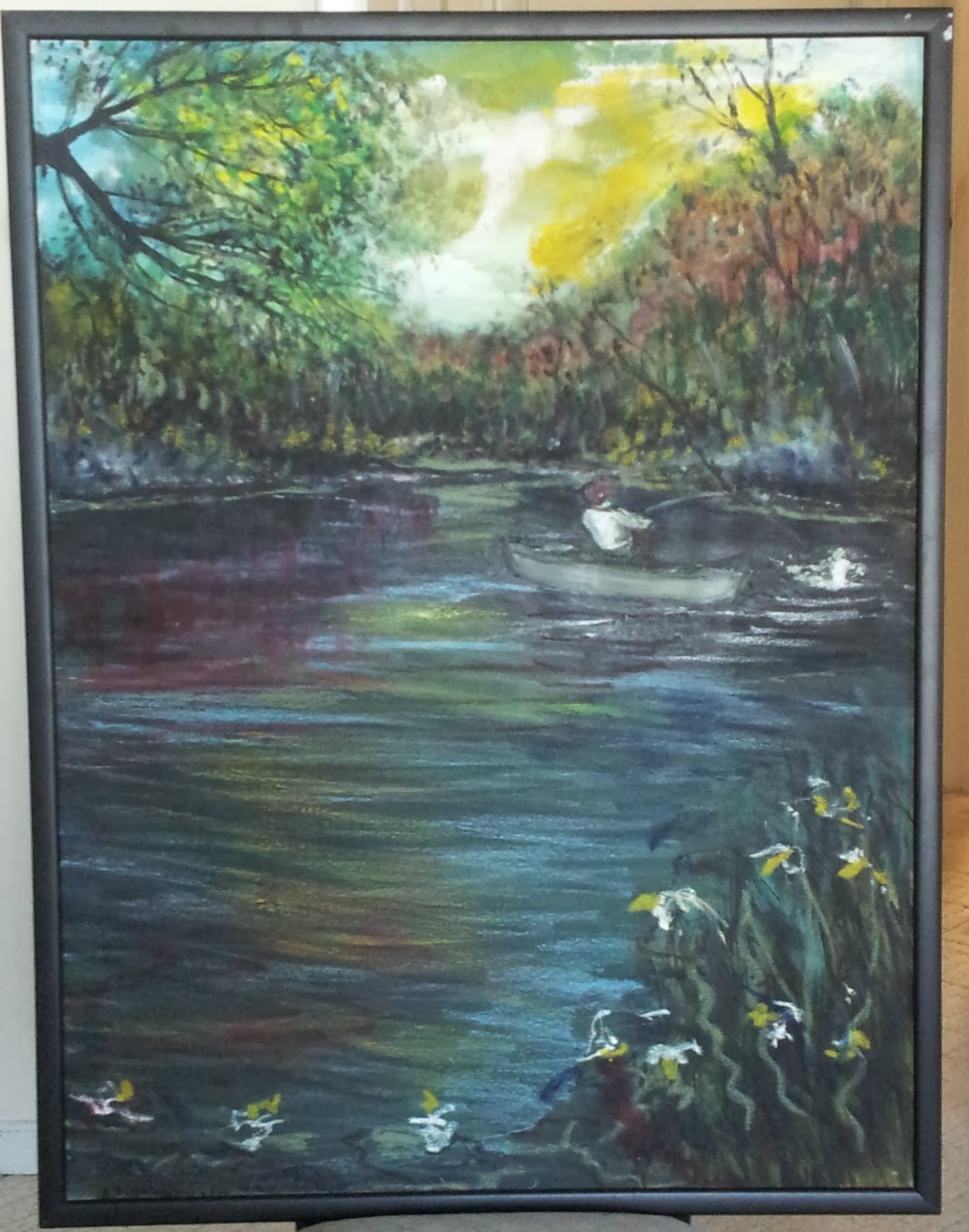
This painting is entitled "My Secret Spot." It initially was in memory of my Grandfather, who took me fishing  to many different lakes when I was younger.  It's funny now how after five years of my own father's passing, how much this painting reminds me of him.  It's a vivid memory, taking a boat to a small lake behind his house, going out on a summer's evening and casting the shoreline.  It would take us about two hours to row once around the lake.  It was a time of connection and talking about the days or week's events.  It's hard to capture a feeling on canvas, so this is more or less a frozen part of time that in my mind, connects both  the memory of my father and grandfather in one serene setting.

 In all my paintings, I usually have such a personal connection to them in different ways.  This painting took about three months to complete, because I would continually go back and rework the background and water areas, trying continually to remember what it was like when I was in the boat.  The water splashing against the shore, the occasional fish jumping, and the soft summer breeze blowing in the trees.  Then, out of nowhere, fish on!  And the excitement would start until we got it to the boat and on our stringer.  It's a moment frozen in time, and a memory I'll have forever.  Now I have the memory on canvas. 

Monday, December 23, 2013

Holiday Inspiration

It seems like after the first snowfall, the landscape takes on a very whimsical nature.  Around the holidays, I'm inspired to paint in that same whimsical way.  The two paintings shown today are "A Dickens Christmas" and "Snowmen: Oh Holy Night."  For some reason, the holidays always inspire me to paint in a whimsical manner.  It's a nice break from abstracts, florals and landscapes, and allows me to practice different techniques.  My snowmen paintings and prints have been relatively popular.  The Christmas Critter dog painting featured on my Facebook page, has drawn a lot of attention. 


When I create a painting such as A Dickens Christmas, it's a culmination of memories from childhood and inspiration from this time of year.  All three of these images are still available for sale and are 30" x 40" oil on canvas.  I have several other snowmen paintings at The Red Geranium Framing & Gifts in Mauston, WI.  They have been a popular draw and gotten many positive comments.  In fact, the store might even display them year-round in a designated Christmas area.


Doing these types of works gives me a break from the traditional, and continues to expand my horizons.  It gives me the courage to venture into other areas with my art.  Many times I surprise myself with the ultimate outcome.  Even though these paintings are seasonal, they're available year-round.  In fact, summer is a great time to contact me about doing a holiday commissioned piece. 

From all of us at Blind Guy Studios (ha ha ha), wishing you a wonderful Christmas and a very happy 2014. 

Monday, November 25, 2013

Emotions in Motion

Every painting that I complete has a certain amount of emotion within its frame.  Some a little more than others.  Some pieces are what I call "emotion paintings."  In this process, the paint, the boldness, the swirls, tell the story of how the composition is laid down.  It's almost like going into a trance and allowing the paint to come alive.  This can change depending on mood, surroundings and other external forces.  These are some of my most favorite paintings because not a lot of thought goes into the finished product.  I also use other ways of getting the paint on the canvas, such as paper towels, fingers, cotton swabs, and very seldom, a paintbrush.  These paintings are free flowing, and a lot of them, I can complete within a day (6-8 hours).  These paintings are a great diversion from trying to compose a landscape or an intricate floral.  The sky is the limit, and you definitely need to know when to stop blending for the end result to have the greatest effect.  I myself am hesitant to title any painting, as I feel that the viewer should take in their own meaning and title it themselves if they wish.  I try hard not to put my influence other than my creativity on the canvas.  Doing these emotion paintings are one of the few times that I can really get in and feel my work taking shape.  This to me is extremely enjoyable, as all my art is, but I feel a greater connection to this type of free-flowing art. 


"Untitled Abstract"

This painting is a great depiction of what I'm trying to explain.  Each swirl tells a story and each color connects with emotion.  From the top of the canvas to the bottom of the canvas is the completed movement.  The movement creates its own energy, and its as if you're sucked into the vortex of the essence of the painting.  This, just like any other piece of art, you can either love or hate.  But in my experience, the connection made with these emotion paintings is immediate. 

Thursday, November 21, 2013

Splatter and 3D

Every time I sit down and try to start a new painting, I continually try to think of new and inventive ways of putting the paint to the canvas.  The first time I tried to do a Pollock-esque painting, I came up with my own individual splatter techniques.  I start with a solid color background, and then basically just continually try and create a composition.  The boldness of the colors and the composition is what makes the painting.  This I found to be quite fulfilling, as I never knew what the end result would be. 
"Untitled"

Eventually, I wanted something more challenging, and decided to try my hand at 3D works of art.  I start with a blank canvas, and rather than applying paint right away, I work with a clay substance called Sculpty Mold and put down a foundation of trees, mountains, streams, etc.  This proved to be quite tedious and time consuming, as the clay was the same color as the canvas.  So not only did I have to find again the sculptures that I made, but had to feel them before I painted them.  I would then go in and put background color on, usually a sky or any type of water (if the landscape required).  Then I'd go in and create the mountain, which the clay itself helps it to look like actual rock.  I surround a lot of this with dark color, which makes the color in the forefront pop, giving it more of a 3D effect. 
"Moonlit Mountain Pass" - 3D Sculpted Art

Currently, I have several of these paintings, one is for sale at Artistic Expressions in Wisconsin Dells, WI.  The others are in my archive collection, and unless they currently exist, I'm only doing these on a commissioned basis.  These two techniques totally help me to stay creative, be constantly challenged, and strive for a better quality in my art.  The end result is always amazing to me, and I can't wait to see how this gets incorporated into future paintings. 

Monday, November 11, 2013

Full Circle

Many years ago, while attending an NFB meeting, I was told by one of the patrons that I was considered in the blind world what was called "a partial."  This basically means that I don't have enough eyesight to drive or function fully as a sighted person, but yet I have too much eyesight to be considered fully blind.  Again, I see peripherally, which means to the sides and up and down rather than the use of the central vision, which is where all your acuity lies.  This is why in many situations, I have learned to use a cane whether I need it or not.  It answers a lot of questions, especially in places like airports.  Several times, while travelling to art shows, I have been looking for a specific concourse and could not find it.  One particular time, I asked a lady behind a customer service counter.   She sheepishly looked over her right shoulder and pointed to the huge "D" marking the concourse, as if to say "duh, there it is..." Instead of responding like "oh, sorry I didn't see it, I slowly raised my cane and she went "oh."  It's situations like that that keeps life amusing and very interesting at times. 

Another thing many people don't realize is that when you are visually impaired and travelling through an airport, they put you in a wheelchair.  At first I was taken aback at this, as I am quite capable of walking, but again, the wheelchair actually speeds up the process of getting from one end of the airport to the other.  It's like getting the rock star treatment, or in my case, aging rock star!   My escape from the headaches of these situations is working on my art.  There, there are no rules, no limitations, and no restraints that hold me back creatively.  If I start a painting, and it doesn't quite work out, oils are very forgiving.  I can wipe it clean and try it again.  I've done this many times, and I call it "mushing."  Its' amazing how out "in the real world" not having good eyesight causes many different problems.  The escape to my studio alleviates all of that. 

"A Floral Frenzy"

Monday, November 4, 2013

Getting Started

One of the hardest things for me as an artist is similar to a writer staring at the first blank page.  Generally, I have an idea of what I want to create in my mind's eye, but more times than not, the painting takes on a life of its own, and I basically fill in the blanks.  During the process, I have to keep tabs on where my colors are.  I mix my own colors, and only buy the primary colors, which are red, blue, and yellow.  Not being able to see these, I keep them in a very orderly fashion in my studio.  Many times (more than I want to count), I've mixed the wrong color and came up with a "happy accident," which could consist of a purple tree or water that is not as blue as the Bahamas. 

It isn't unusual for me to be working on several canvases at the same time.  When an idea pops into my head, I like to get as much done as possible, then continually come back to it and refine the painting.  I have been called very prolific and eclectic when it comes to my work.  It may take me several weeks to several months to complete a project that I started in this way.  It mostly depends on the content of the painting. 

Over the years, I have been my own worst enemy in overworking some of my art.  Knowing when to stop is just as important as knowing how to start.  The completed work usually speaks for itself.  I am my own worst critic when it comes to knowing when the piece is finished.  It's not unusual for me to place a finished piece in my drying rack for several months, then learn a new technique, and then go back and rework a finished painting.  The abstracts obviously are the easiest, but I work really hard on their composition.  The florals seem to come relatively easy to me, and I have been told they look like Van Gogh rip offs.  The landscapes are the most detailed and take the longest, but in the end are the most fulfilling for me as an artist.  It never ceases to amaze me seeing all my works at a show and thinking, "wow, I created that," especially knowing how they got started.

Monday, October 21, 2013

The Process

After any showing or art venue, the question I'm asked most often is: "Okay, you're legally blind, how do you do this?"  I first start off by explaining my vision loss, which is my entire central vision.  It's skews color and depth perception.  I do have peripheral vision, which is lacking the acuity so I substitute that with contrast.  I try to focus on quadrants of the canvas, rotating in a clockwise position, working very close to the canvas until the picture is completed.  Many times I try to mix my own colors, and I come up with what I call "happy accidents."  It's not unheard of for one of my landscapes to contain purple trees. 
Depending on the size of the painting, and whether its a landscape, abstract or floral, it can take up to 8 weeks to complete a painting.  Many of the landscapes, I will go back to several times before they are totally finished. 


In  many cases, I can have up to three different paintings at the same time.  One can be a simple abstract (in which I focus on composition), a more intricate landscape, and a fun floral.  Depending on my mood, I can spend as much as three hours on each painting during each session.  I don't necessarily stick to these three genres, as my commissioned work has included animals, themes from music CDs, etc.  In other words, I change things up all the time.  It's never a dull moment when painting.